nanoRETE, Inc. Receives Air Force SBIR Contract for Devel-
opment of Pathogen Biosensor
Lansing MI based
nanoRETE
has been awarded an Air Force SBIR
contract for the development of a field-ready, real-time biosensor
for the detection of tuberculosis. nanoRETE is developing cost-ef-
fective nanoparticle biosensors that can detect multiple pathogens
and toxins while generating screening results in less than three
hours. Development work will take place over a two year period,
with an estimated funding level of $750,000.The company has also
been awarded a matching grant for $125,000 under the State of
Michigan’s Emerging Technology Fund (ETF) to help support and
expand the efforts under this program.
Oxygen-sensing microrobots
Researchers of the multi-scale robotics lab
at ETH Zurich have now developed a micro-
robot that can measure the retina’s oxygen
supply.“I picture it like the robots that we
use these days to chart the ocean floor”,
comments
Bradley Nelson,
ETH-profes-
sor and head of the Institute for Robotics
and Intelligent Systems.“With our microro-
bot we can chart the oxygen levels of the
inner eye liquid – the vitreous - along the
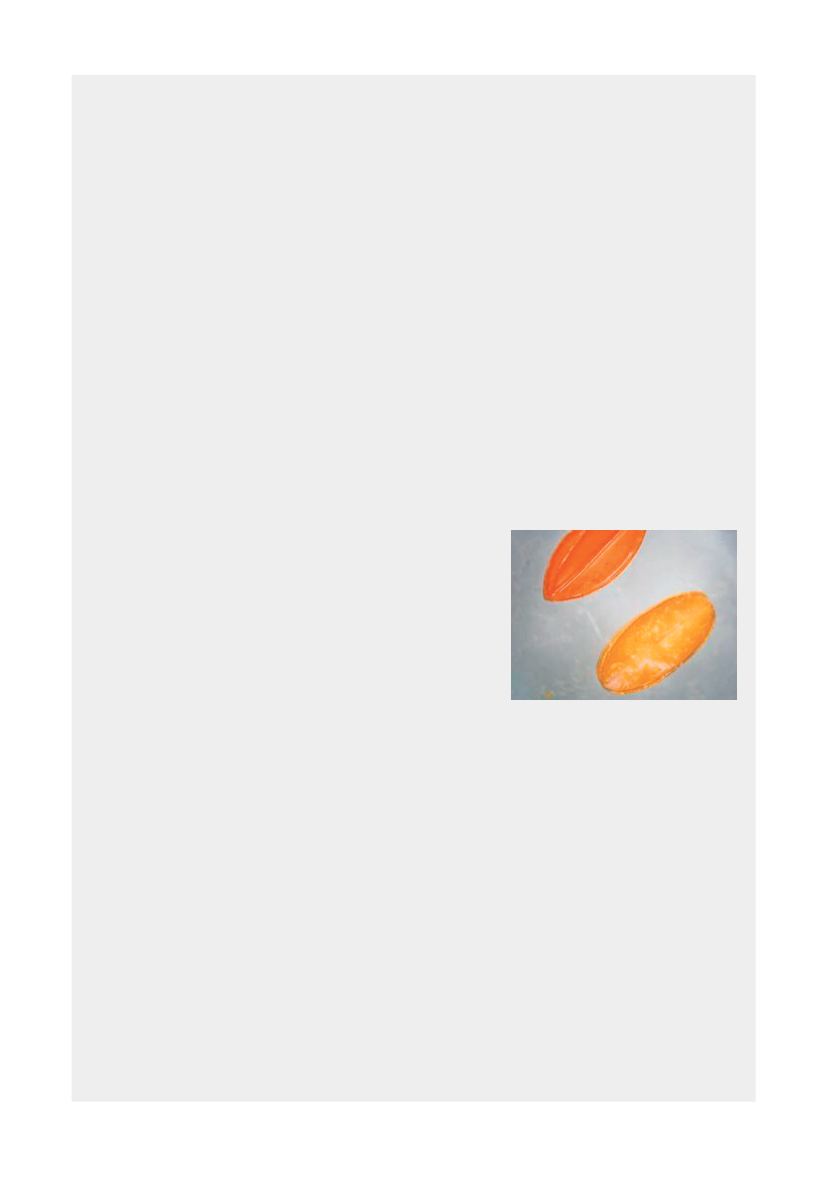
retina.” A mere millimeter in length and one third of a millimeter in
diameter, the robot can move through the vitreous, guided by mag-
netic fields that allow the researchers to precisely steer it into posi-
tion. The sensor incorporates a dye, which when excited by light at
the correct wavelength, emits fluorescence which fades with time;
the rate of fading depends on oxygen levels.
A microrobot to measure
the eye’s oxygen supply.
(from Ergeneman O. et al,
IEEE Tran Biomed Eng. 2012)


