Cambridge CMOS Sensors Develops IR Sensor for Breath
Analysis
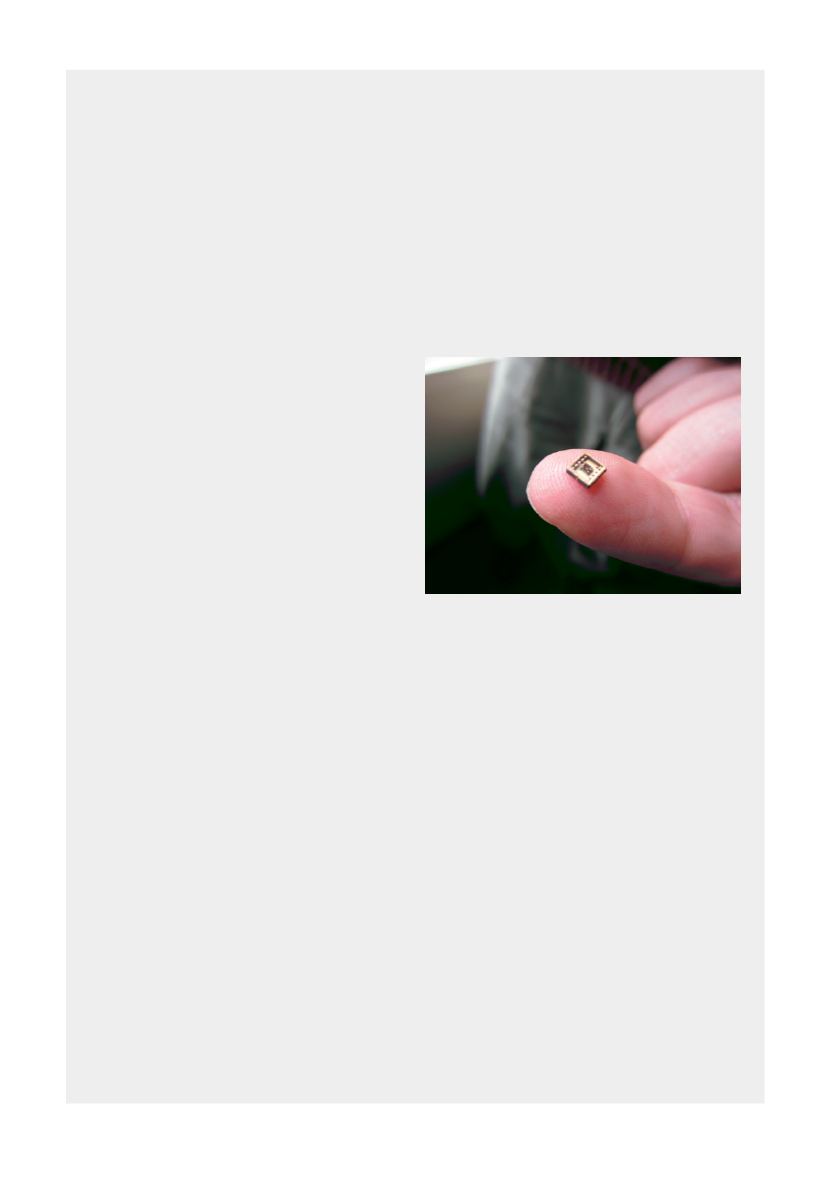
The highly sensitive, low-power, low-cost infrared emitter developed
by Cambridge CMOS Sensors (CCMOSS) is capable of identifying
more than 35 biomarkers present in exhaled breath in concentrations
as low as one part per million, and is being developed for use as a
non-invasive medical testing device and other applications.
The technology developed by
CCMOSS uses broadband in-
frared radiation to make the
detection of a wide range of
biomarkers possible in a single
device.The company’s min-
i-
ature heaters, or microhotplates,
can be heated from room tem-
perature to 700°C in a fraction
of a second, a temperature high
enough to emit infrared radiation useable to detect gas molecules.
“Non-invasive breath analysis is an area of great potential for diagnos-
ing and monitoring a wide range of medical conditions,” said Professor
Florin Udrea of the Department of Engineering and CCMOSS’ CEO
and co-founder.“Testing is easy and painless, and can be repeated as
often as needed.”
Using broadband infrared, the company’s gas sensing technology can
detect wavelengths between two and 14 microns, corresponding to
a wide range of biomarkers. In order to detect different wavelengths,
a filter is applied on top of the detector, meaning that only infrared
radiation of a particular wavelength can get through.


