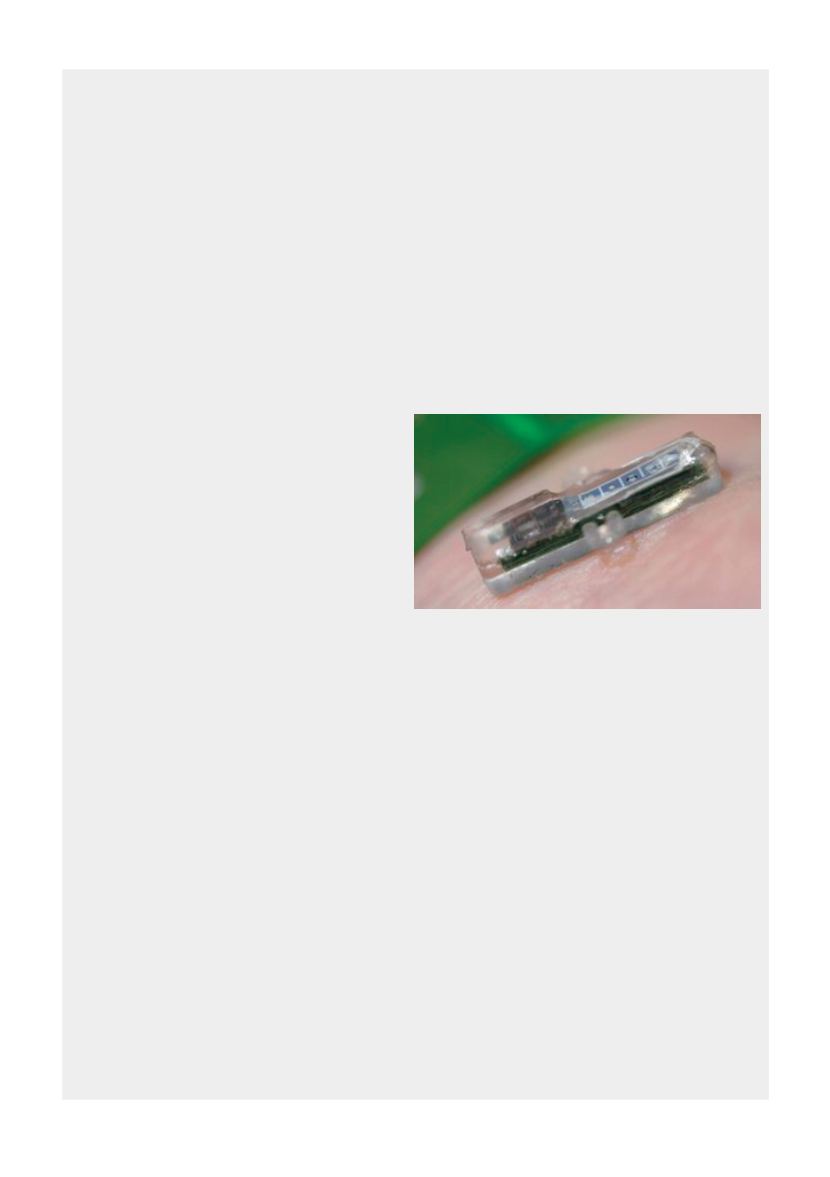
Under the skin, a tiny laboratory
Swiss consortium Nano-tera.ch project i-IronIC, led by
Prof. Gio-
vanni De Micheli
, EPFL, has led to the development of a tiny, port-
able personal blood testing laboratory: a minuscule device implanted
just under the skin provides an immediate analysis of substances in the
body, and a radio module transmits the results to a doctor over the
cellular phone network.This feat of miniaturization has many potential
applications, including monitoring patients undergoing chemotherapy.
The implant is only a few cubic millimetres in volume but includes five
sensors, a radio transmitter and a power delivery system. Outside the
body, a battery patch provides
1/10 watt of power, through the
patient’s skin - thus there’s no
need to operate every time the
battery needs changing.
To capture the targeted substance
in the body - such as lactate, glucose, or ATP - each sensor’s surface
is covered with an enzyme.“Potentially, we could detect just about
anything,” explains De Micheli.“But the enzymes have a limited lifespan,
and we have to design them to last as long as possible.” The enzymes
currently being tested are good for about a month and a half; that’s
already long enough for many applications.“In addition, it’s very easy to
remove and replace the implant, since it’s so small.”
The prototype has already been tested in the laboratory for five differ-
ent substances, and proved as reliable as traditional analysis methods.
Researchers hope the system will be commercially available within 4
years.


